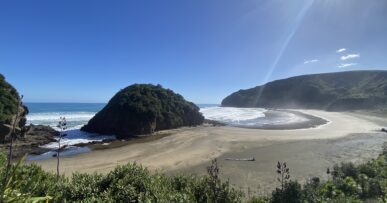
In this article we want to share with you our experience on Niue. We went there for a week in June 2024 and we loved it! Click on the section of your interest of scroll down to read the article:
- Niue? Never heard…
- How to get to Niue
- How to get around the island
- What to do on Niue
- Food on the island
- Fun Facts about Niue
Niue? Never Heard…
Never heard of Niue? Don’t worry, you are probably not the only one unless you live in the South Pacific or in New Zealand! We actually discovered Niue when we moved to New Zealand and we felt in love to idea of going to this little island in the Pacific since the very first time we heard about it. Finally we made in June 2024 and what we found there overcame our expectations.
Niue is a tiny island nation in the South Pacific that, like the Cook Islands, is in free association with New Zealand. The island-state has its own Parliament but Defence and Foreign Affairs are responsibility of New Zealand.
Niue has been one of the latest islands subjugated by the European colonialism. Indeed, although Captain James Cook located the island in 1774, he was unable to land. The inhabitants refused to grant him permission on three different occasions, and the island was since named “Savage Island” by the Europeans.
Over a century later the island changed its name to Niue. What does Niue mean? Niue, in Niueans, means “Look! A coconut tree”, where “Niu”, means “coconut tree,” and “e” means “behold,” or “look”. According to a local guy we met, these were the first words of the first people who arrived on the island.
Niue remained isolated and, after several failed attempts to land a European missionary on the island, the London Missionary Society decided to abduct a local, Nukai Peniamina, bring him to Samoa and convert him in the hope that he would be accepted on his return to the island and he could convert the local population. Despite the first reticence, eventually Peniamina was allowed to land in Mutalau and spread the word of Christianity around the island.
Thanks to the support of the Cook Islanders, who ask the permission to the Queen Victoria to annex Niue into the British Empire, Niue became first a British protectorate and then a New Zealand one. The island finally regained independence with a referendum in 1974.

How to get to Niue
Niue can only be reached by plane from Auckland, New Zealand. There are two flights a week leaving Auckland on Tuesdays and Saturdays.
The flight takes just about 3 hours, but the time difference is of 23 hours! So, if you leave on a Tuesday, you arrive the day before, on Monday, and if you leave on a Saturday, you arrive on Friday.
As for the return flights, you can fly back to New Zealand on Mondays and Fridays. And you’ll arrive the day after in Auckland.
Of course, it’s easier to check out Air New Zealand for fares and timetables, but how cool time zones are!
Last but not least, you better book a seat on the left hand side of the plane – looking at the control cabin – to have a better view of the island both on landing and take off.

How to get around the island
Niue is very small and there are 5 roads in total: one going around the island, and four going across. Some of the roads on Alofi side (Alofi being the capital) were being repaved by China Aid at the moment of writing – July 2024, while the ones on the opposite side of the island are quite old and run-down.
We’re not going to talk about the fact that China was paving Niue’s roads and that the 30ish Chinese workers were left in their own compounds next to the airport, but we’re going to tell you that there is no public transport on the island so you should definitely rent a car to get around.
Our accommodation – Aleki Guesthouse – included a rental car in their price and we found it very convenient (160 NZD per night, two people with a car).
Otherwise, you can rent one at the airport, the two rental car services will be there at their desk waiting for you.

What to do on Niue
Niue as been the most tourism-wise organised island we’ve been to! There are not many tourist, but they surely treat them well.
As soon as you arrive at the airport, after collecting your luggage, you are given a brochure, a map, and an A4 paper with everything you need to know for the week you’ll be staying on the island.
You can also find the brochure information on their website niueisland.com, but we found it very handy to have a brochure with us. As for the info paper, this is gold! You’ve got café and restaurants opening times as well as low and high tides time. These are crucial to enjoy the island as most of the snorkelling and the coral watching can only be done at low tide.

Snorkelling and Coral Watching
Snorkelling and coral watching is definitely the most popular activity. Indeed, you can simply walk on the rock that surrounds the island to see beautiful and colourful corals at your feet! Please be careful not to step on them. Also, you’ll be able to swim in natural, crystal clear pools surrounded by corals and fishes.

These awe-inspiring snorkelling spots are often accessible by short sea tracks from the road to the beach and then by walking on the reef. Our favourite spot at low tide was Hio Beach – and Hio Cafè is also highly recommended.


On the other hand, Avatele Beach is best at high tide as you can safely swim and see the coral reef and its fishes close to the beach. Just beware the current on the right hand side towards the open ocean.

You can also book a snorkelling tour with Niue Blue to get out of the reef and swim in the open ocean! You’ll snorkel in different locations to see new and old corals, but don’t expect them as close as at Hio or Avatele beaches. However, the main goal of this tour is to see and swim with dolphins, which is truly amazing! Also, it’s very nice to see the island from the ocean and to hear more about Niue history and marine life.
Finally, if you go to Niue from mid-July to the end of August, you’ll be able to see and swim with humpback whales. We missed them, unfortunately.
Diving
Guido did the Open Water course with Niue Blue and we strongly recommend to do the same or even just a dive with them if you are already certified. Indeed, Niue is meant to be one of the best pacific islands for diving thanks to its visibility that can reach up to 50m! They have different spots they can bring you out to and all the instructors are very knowledgeable and approachable people. Most of the diving instructors at Niue Blue work also at Tutukaka in New Zealand and they will be able to give you tips about diving in New Zealand, especially at Poor Knights, which is meant to be one of the best diving spots in Aotearoa.


Walking and Caving
There are many sea tracks on the island and they are all well marked and safe to walk. On Alofi side – the left side of the island, looking at the map – these tracks lead you to caves or small beaches, and to accessible, walkable, and safe reef in low tide.
The most accessible cave is Avaiki Cave, it opens up on the ocean reef and you can swim inside it. Also, you can walk out on the reef a bit and see more corals. Low tide is essential.
Talava Arches is a great 45-minute walk through an ancient coastal forest which leads you to a cave and then down to the reef where you can snorkel and enjoy the view of the arches. Again, low tide is essential.


On the right side of the island, looking at the map, the sea tracks are as spectacular and lead you to rocky viewpoints. You can’t swim on this side of the island, the ocean is rough and cliffs are often high.
We particularly loved the 30-minute walk and the view we got at Togo Chasm. You fist walk through an ancient coastal forest – if you look closely to the rocks, you’ll see they are actually fossilised corals! Then the track opens up into a landscape of razor-sharp pinnacles and sink holes.

Follow the cemented path till it ends. Here there are two things to see. If you go on your right, there is a ladder to descend into the Togo Chasm where two inland beaches and palm trees will make you feel you arrived in a small paradise.


If you go on your left, take a few steps among the rock spikes to get to a roof window which opens up on the roaming ocean. Here a natural bridge can be seen spanning the water. You can do the walk at any tide.

There are many other and are all clearly marked on the island map and tide-related info can be found on the brochure as well.
Food on Niue
If there is one thing that disappointed us was, unfortunately, the food. In fact, we hardly found any fresh product and most of the food at the supermarket was either in can or frozen. It wasn’t the season for bananas and papayas, so coconuts were the only fruit available.
What about fish? Well, even there, we thought it would be better. From what we were told, there are now very few fishermen on the island and they only sell fresh fish to the local restaurants. For fresh fish, we recommend the buffet at Manuiz restaurant and the tuna tacos at Hio Café (check the opening time on the brochure).

You can bring some food from New Zealand but, as in many other Pacific Islands, fresh products are not allowed. We sticked to the rules and we didn’t bring anything but we noticed that some people brought meat from New Zealand. We do not suggest that, since these rules are there to preserve the beauty and the uniqueness of these places.
If you want to try a local delicacy, you should try the Uga, the famous coconut crab of Niue. You will not find it at the restaurants but you might be lucky and find it at the local market, where you can also meet local women and buy souvenirs.

Fun Facts about Niue
How many people live in Niue?
In 2024, there were only 1,600 people residing permanently on Niue while over 30,000 Niueans lived in New Zealand, especially in Auckland, which is home to a vast community of Pasifika and to the biggest community of Niueans out of Niue.
We didn’t count them but there is probably more rooster than people on the island. If you are light sleeper, we would recommend you bringing good ear plugs.
Are there any special coins in Niue?
In 2021, the government of Niue issued Pokemon coins depicting Pokemon on one side and the Queen Elizabeth on the other (Betty must have been super happy…). We obviously enquired about it when we were on the island but we were told there are not in use anymore.
Are there sandy beaches on Niue?
Niue is one of the largest coral islands in the world! It was formed by volcanic eruption 2 to 3 millions years ago and that’s why it is also known as the “rock of Polynesia”. Thanks to its geology and the lack of sand, Niue is one of the islands with the best visibility in the Pacific. There is one semi-sandy beach – Hio Beach – and a coral beach – Avatele beach, but the rest is all rock! So, do not forget your reef shoes!

The forest grows on the rocks in Niue
Can I see the stars in Niue?
Absolutely! Niue is the first dark sky nation in the world, offering unparallel opportunities for stargazing and astronomy. There are many spots from where you can admire the stars, we loved one on the road between Avatele and Alofi!

Is there a rugby team in Niue?
There used to be a rugby team in Niue but not anymore. Nowadays the Rugby Club is the place to go for a party on Saturday night. Despite the place closes at midnight, all the locals go there at 11:30pm for the last 30 min. We were there at 10pm and we were alone with just the barman, we had to wait for the party to start!
Are there any cultural activities you can do in Niue?
You can learn how to weave from local women on Niue, Giulia was also quite successful!


What about religion in Niue?
As in many other Pacific Islands, religion is an important aspect of the life of every Niueans and all locals go to church on Sunday. You should absolutely try to attend a mass on Sunday even if you can’t stay there all the time. Also be aware that you are not supposed to swim at the village beach on Sunday (Avatele beach for example) and you cannot wear only a bikini in the village.

Is there a prison in Niue?
Incredibly enough, there is a prison in Niue! When we were leaving we spoke with a local policeman who told us that in June 2024 there was only one inmate in the prison. From what we were told, the inmate was allowed to have family visits, bring his own food and bed from home and even go out of the prison as long as they remain within the perimeter of the golf course. Apparently the inmate and the policemen have their own “golf team” and they are also pretty good….unsurprisingly since there is not much to do for them all day…
Is it safe to drive in Niue?
There is no traffic lights on Niue. No many cars means no need of a traffic light! Set yourself on the island time and enjoy the relaxed pace.

Was it enough to convince you to go to Niue? Explore other Pacific Islands if you want to discover other nations in the region!